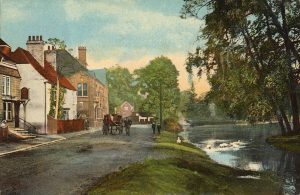
John Frith was born in Westerham around 1503. No portrait of him is known to exist. He was an exceptional scholar and was invited by Cardinal Wolsey to join his Oxford college. As he studied the New Testament, he became increasingly aware that some of the Church’s doctrines were not taught by Christ or His apostles. This led to Frith’s rejection of the doctrine of purgatory and also his denial of transubstantiation, whereby the substance of the bread and wine in the Eucharist is believed to be completely changed into the body and blood of Christ, while still appearing to be bread and wine.
With his life in danger, he fled to Antwerp to find his friend and fellow reformer, William Tyndale, who was immersed in the work of translating the Bible into English at a time when the established Church did not approve of the general public having direct access to the Word of God.
Frith eventually returned to England but was arrested and imprisoned. Convicted of heresy, and declining every opportunity to recant, he was burnt at the stake in 1533.
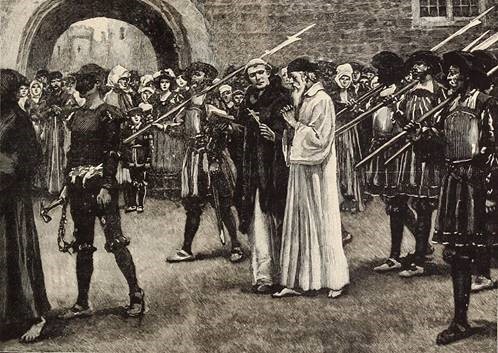
Frith was an intellectual and spiritual leader whose writings and actions helped shape the direction of the English Reformation and later influenced the Book of Common Prayer. He was a gentle scholar and an important voice for religious tolerance, arguing against the persecution of individuals for their faith. His courage and intellect were praised by fellow reformers, and his life and death secured his place as one of the earliest English martyrs of the Reformation.
A curious story surrounds some of Frith’s writings, which were discovered by a Cambridge fishwife, wrapped in sailcloth inside the stomach of a cod caught at King’s Lynn. This remarkable find took place on 23 June 1626. The identity and authenticity of the books were verified by numerous scholars, including Dr Joseph Mede of Christ’s College, Cambridge.
The texts were published the following year with a preface by Thomas Goad, under the title Vox Piscis, or The Book-Fish, contayning three treatises which were found in the belly of a cod-fish in Cambridge market, on Midsummer Eve last.
It remains unknown how the original books came to be inside the fish.
Norman L Hopkins
[Précised from a Westerham Society talk given by Mr Hopkins at Westerham Hall on 14th November 2025.]